 You are here:
Auto-Feed Riveting Gun Buying FAQ for First-Time Buyers
First-time buyers of an auto-feed riveting gun (also called an auto-feed rivet machine or high-force automatic rivet gun) tend to ask the same handful of questions: are you the factory or a trading company, how long is the warranty, what is inside the machine, which products can it fasten, and how do domestic and imported machines compare. This article collects the purchasing questions Antec handles every week and gives you verification steps you can run yourself. Global customers can book a free on-site trial, and a rivet specification sent in gets a proposal and a price range in about 10 minutes.
Bulk buyers usually compare total cost per rivet rather than the machine price alone, because consumables and wear parts dominate that number. The notes below cover auto-feed riveting gun supply and procurement.
What buyers who source machines, rivets and spare parts in one order should remember: are you the manufacturer, and how long is the warranty?; what makes up an auto-feed riveting gun, and what can it fasten?; what sets the sheet metal model apart?; domestic or imported rivet machine: how do you choose?.
1. Are You the Manufacturer, and How Long Is the Warranty?
Antec (ANTEC) designs and builds auto-feed riveting guns, high-force rivet nut guns and robotic riveting cells. Our manufacturing base is at No.137, Zhongkai 6th Road, Chenjiang Subdistrict, Zhongkai High-tech Zone, Huizhou, Guangdong, where we have focused on automatic riveting equipment for 16 years, delivered 3296+ riveting solutions and served 1369+ enterprise customers. We hold utility model patents and are certified under an intellectual property management system. Customers are welcome to visit the plant and watch assembly, commissioning and trial runs end to end; if travel is difficult, an engineer can bring the machine to your site and run samples on your parts.
After-sales policy: the complete machine carries a 1-year warranty, with a 7-day return and 15-day exchange for quality problems that are not caused by operator error. After the warranty period we continue to supply parts and repair service, and wear parts such as nosepieces and jaws are supplied at cost. One point deserves emphasis: a rivet machine is a multi-year purchase, so wear-part availability and response time matter more than verbal promises. Put these terms in the contract.
2. What Makes Up an Auto-Feed Riveting Gun, and What Can It Fasten?
| Component | Function |
|---|---|
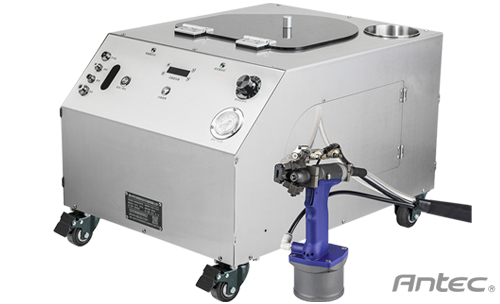
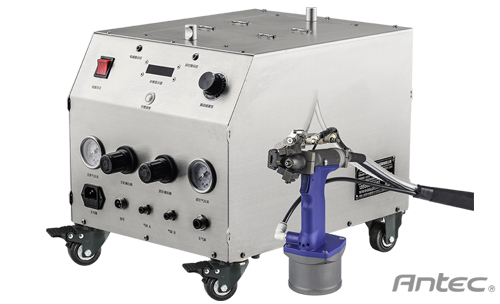
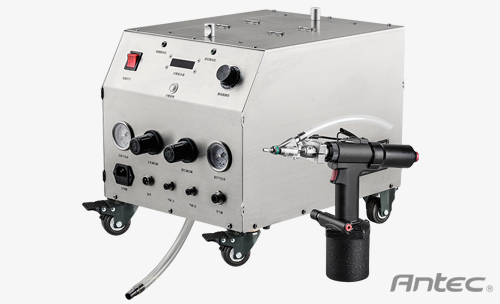
| Main unit (vibratory bowl feeder / hopper, sorting and feeding) | Sorts, separates and blows rivets to the gun; the core of stable operation |
| Rivet feed tube (material tube) | Carries rivets to the nosepiece; length configured to the workstation layout |
| Rivet gun body / nosepiece | Clamps, pulls and breaks the mandrel; nosepiece changed to match rivet head diameter |
| Control system (PLC / touch screen) | Counting, parameter settings, low-rivet and fault alarms |
| Workbench / fixture (fixed version) | Holds the workpiece and keeps hole positions repeatable; the custom-engineered part |
| Robot (robotic cell) | Replaces manual positioning; suited to high-volume runs at fixed points |
Typical industries include computer, server and telecom enclosure & cabinet work, automotive and auto parts, new-energy lithium battery and photovoltaic, sheet metal and power distribution cabinets, home appliances and kitchen equipment, and aluminum fabrication and ladders. Typical workpieces are chassis panels, cabinet frames, battery trays, appliance shells, aluminum curtain-wall panels and bracket assemblies. If a part uses blind rivets (pop rivets) or rivet nuts and runs in any real volume, it is worth evaluating automation.
Bulk orders are packed together, so the line is not waiting on a partial delivery.
3. What Sets the Sheet Metal Model Apart?
Sheet metal parts (cabinets, power distribution cabinets, door panels, mounting plates) share three traits: a wide spread of material thickness, many rivet points, and frequent product changeovers. An auto-feed riveting gun built for sheet metal work therefore reinforces three things. First, the feeding mechanism has to handle a range of rivet lengths, so a changeover is mostly a nosepiece swap and a track adjustment. Second, the gun body needs resistance to off-center loading, because hole tolerances on sheet metal are unavoidable and the nosepiece needs some float to self-center. Third, the layout has to suit large panels, where a handheld gun on a mobile feed rack and a fixed workbench both work. For high-mix, low-volume sheet metal shops, a handheld or fixed standard machine is the most cost-effective starting point.
4. Domestic or Imported Rivet Machine: How Do You Choose?
| Point of comparison | Imported brands | Domestic (e.g. Antec) |
|---|---|---|
| Purchase price | High, often several times more | Clearly lower, with fast payback |
| Delivery and customization | Long lead times, expensive non-standard engineering discussions | Standard machines ship from stock; non-standard builds engineered to your workpiece |
| Parts and after-sales | Expensive parts, long waits | Wear parts at cost; factory engineers can come on site |
| Core performance | Mature and stable | Meets mainstream production needs; the gap has narrowed sharply |
| How you verify | Look at a catalog | Free on-site trial, tested on your own workpieces |
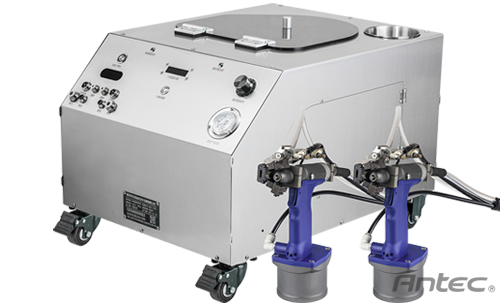
Our honest advice: do not decide on the assumption that imported is always better and domestic is always worse. Give two or three suppliers the same rivet specification and the same acceptance standard, then compare cycle time, yield and continuous feed reliability in a live sample run. Domestic machines are already proven across mainstream enclosure & cabinet, sheet metal and appliance work, and putting the savings into a dual-gun machine or a second unit often delivers more capacity than a single imported machine.
Specification customization is quoted with the machine, not as a separate negotiation.
5. How Should You Read Manufacturer Claims and Performance Specs?
Every supplier claims speed, stability and labor savings. The claims worth weighing are the ones you can verify: 30000 consecutive rivets with no jam in a continuous pull test, typical pull force around 12800N (higher pull force available on request), a cycle time of about 70 cycles/min, one machine replacing about 3 operators, roughly 0.3% failure rate, about 78% repeat purchase rate, and payback in 2-6 months on a typical line. These figures come from in-house testing and customer data; the real numbers for your parts come from a free on-site trial. Be cautious with any supplier that refuses on-site verification and offers only verbal assurances.
6. What Is the Right Process for a First Purchase?
Step one: assemble your rivet specification (type, head diameter, body diameter, length, material) and your part data (drawings or photos, material thickness, rivet points, annual volume). Step two: send it to two or three suppliers for a proposal and a price range. Step three: arrange a trial at your site or at the factory and record continuous feed success rate, time per part and yield. Step four: check the configuration, wear-part pricing and warranty terms on the quotation before you sign. Step five: on delivery, accept the machine in two stages, no-load and under load. For the full walkthrough see the auto-feed riveting gun ordering process, and for the traps to avoid see 5 selection mistakes to avoid before buying an automatic rivet machine.
Purchasing FAQ
Auto-Feed Riveting Gun Buying Questions
Q1: Why do quotations vary so much?
The differences sit in pull force, single or dual gun, feeding method, workbench and non-standard engineering scope, and the grade of the components. Low-price machines usually cut corners on the feeding mechanism and on branded components, so ask for an itemized quotation with the configuration written out. See the complete auto-feed riveting gun buying guide.
Q2: Can I buy the main unit without a workbench?
Yes. A handheld gun package does not include a fixed workbench. If your parts are small and the rivet points are fixed, add a fixture or a fixed table; decide by your actual workstation.
Q3: How soon can an engineer come out after a service call?
We support customers worldwide. Once you book, an engineer arrives with a matching machine and runs samples on your parts; the exact date is confirmed when we schedule the visit.
Q4: Where can I see the equipment, and how do I compare channels?
Visit our manufacturing base in Huizhou, or book an engineer to run a trial at your site. For a channel comparison see where to buy an auto-feed riveting gun.
Q5: How fast is the payback?
Run the numbers on replaced labor, yield improvement and uptime; a typical line pays back in 2-6 months. For the logic and the signals that you are ready, see why you should move to a non-standard automated riveting cell.
Global Customers: Send Your Specs, Get a Proposal and a Price Range in 10 Minutes
16 years as a source manufacturer: standard machines ship from stock, and non-standard builds are engineered to your workpiece. Run a free on-site trial before you decide. Call +86 13556668682.
Further reading: Antec auto-feed riveting guns: factory strength and product range · free on-site trial policy and process · auto-feed riveting gun selection advice
Auto-Feed Riveting Gun at a glance: 20,000 N pull force, 70 rivets per minute, bulk orders shipped worldwide, one-stop supply of machines, rivets and parts.
Send the annual rivet consumption and the equipment list - the team will quote the whole package in one offer.
One supplier for the whole riveting process
Tell us what you buy today and in what volume. We will consolidate the machines, the consumables and the parts into one offer.
 Previous