 You are here:
Auto-Feed Riveting Gun: 5 Selection Mistakes to Avoid
Before You Buy an Auto-Feed Riveting Gun: 5 Selection Mistakes and How to Verify a Machine On Site
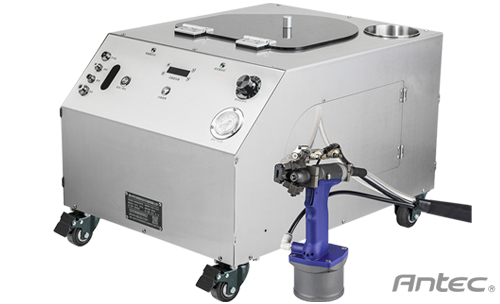
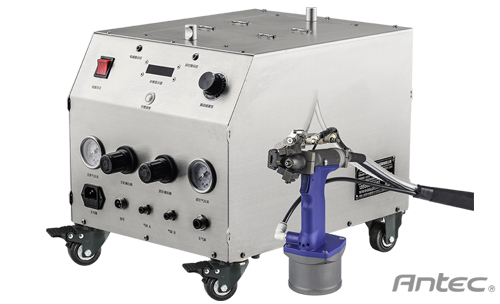
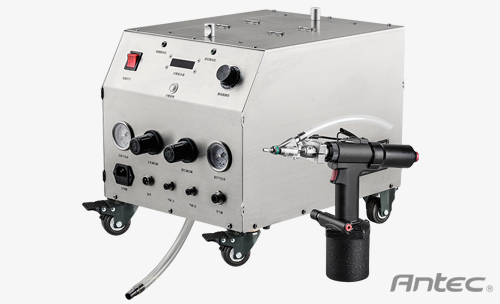
Panels and frames for computer chassis, server cabinets and telecom enclosures are held together with rivets by the thousand. The work used to be done with hand high-force automatic rivet guns, and joint quality moved with however the operator was feeling that day; missed rivets, stripped threads and scratched paint all came back as rework and customer complaints. Switching to an auto-feed riveting gun is now common practice, but plenty of plants still get their first purchase wrong. With 16 years in the business and 3,296+ delivered riveting solutions behind it, Antec has seen the same five selection mistakes again and again.
Procurement gets simpler when the machine, the matching rivets and the original spare parts come from one supplier on one order. The notes below cover auto-feed riveting gun supply and procurement.
For buyers who source machines, rivets and spare parts in one order, the essentials: comparing the machine price instead of the total cost; ordering before the rivet specification is settled; taking "several times faster" on someone's word; overlooking feed stability, the one metric that matters most.
Mistake 1: Comparing the machine price instead of the total cost
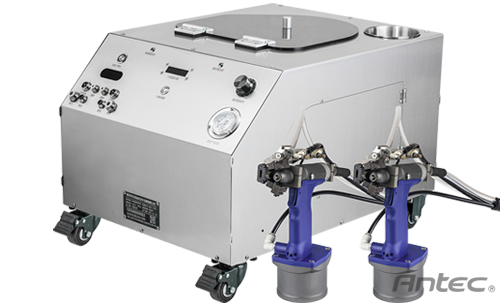
Two machines sold under the same name can sit far apart in price, and the gap usually comes from pull force, feed method, single or dual gun, and the grade of the components inside. Shop on the purchase price alone and you can end up with a machine that feeds badly and has no parts support behind it; one day of lost line time usually costs more than the difference. Run the whole equation instead: purchase price, labor saved, yield gained, capacity gained. On a stable batch line, payback is commonly 2-6 months.
A single supplier shortens the approval cycle for both the machine and the consumables.
Mistake 2: Ordering before the rivet specification is settled
The feed channel, the nosepiece and the pull force are all designed around one specific rivet. Change the head diameter, the body diameter, the length or the material and the machine configuration changes with it. Sort out the physical rivets or the datasheet, the workpiece drawings and the sheet thickness first, and get the supplier to commit in writing to the size range it will run reliably. If you build several products, confirm how the machine changes over and how long that takes.
Mistake 3: Taking "several times faster" on someone's word
Riveting speed depends on rivet length, feed distance, how the points are distributed and how skilled the operator is, so an absolute number quoted without the application tells you nothing. A typical Antec model runs about 70 cycles/min and replaces about 3 operators, for an overall gain of up to about 3 times, and every one of those figures should be confirmed on your own floor rather than taken from the maximum in a brochure.
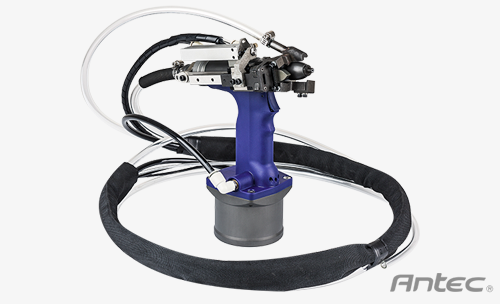
Price per rivet, not price per machine, is the number that survives the first year.
Mistake 4: Overlooking feed stability, the one metric that matters most
The whole value of an automatic machine is feed that runs without jamming. Judge a feed system on whether the sorting mechanism is built for your rivet, whether it detects a missing or jammed rivet, and whether the reload and correction logic is dependable. Every Antec machine is tested to 30000 consecutive rivets without a jam, and the long-term failure rate is about 0.3%. When you are choosing, ask the supplier for continuous-run records on the same rivet you use.
Mistake 5: Buying without a trial run
A spec sheet and a video are no substitute for a real sample run. The safe sequence is to send rivet samples or specifications first so the supplier can shortlist a matching model, then have the machine brought to your plant and proved on your own parts. Antec does not charge for a standard on-site trial and gets back to you within 1 business day of your request.
6 Numbers to Verify During an On-Site Trial
| What to check | What a pass looks like |
|---|---|
| Continuous feeding | A full batch runs with no visible jams or missed rivets |
| Cycle time | Time it on site; average the seconds per part and per rivet point |
| Joint quality | The mandrel breaks cleanly and fully, no stripped threads, no visible scratching on the part |
| Pull force and joint strength | Sample the pull-out force to your requirement; no loose rivet points |
| Changeover time | Nosepiece and feed channel adjustment for a new size takes an acceptable time |
| Operator skill required | An ordinary operator can run it independently after short training |
Bring rivet samples, the parts you rivet, your current manual cycle time and your daily output target. The engineer will measure pull force, cycle time and yield on the spot and recommend the model, the fixture and the line layout. For how this plays out on server chassis and telecom cabinet lines, see the aluminum enclosure and electrical cabinet production case.
What Each Industry Should Look At
| Industry | Typical parts | What to focus on |
|---|---|---|
| Computer, server and telecom chassis and cabinets | Panels, frames, covers | Many rivet points and frequent changeovers, so prioritize feed stability and fast nosepiece changes |
| Automotive parts | Brackets, interior parts, assemblies | Pull-force headroom and consistency; on high-volume lines, favor a dual gun or a robotic cell |
| New energy, lithium battery and solar | Battery trays, structural parts, frames | Fixed rivet points at high volume, so look at robot integration and pull-out force data |
| Sheet metal, power distribution cabinets, appliances and kitchen equipment | Cabinet bodies, housings, brackets | High mix and low volume: a handheld standard machine is flexible and pays back fast |
Riveting looks different from one industry to the next. Automotive and auto parts, electronics and enclosure work, new energy battery and solar, sheet metal fabrication, power distribution cabinets, and appliance and kitchen equipment each put their own demands on a machine. Tell the engineer what your industry actually runs and the proposal gets sharper. See industry application solutions for more.
Common questions about the trial run
Buyer Questions
A standard on-site trial is free. An engineer brings a matching machine to your plant and runs your own parts. If a project needs special custom work, any cost is explained when you book.
Yes. The trial exists to confirm the solution on both sides and carries no obligation to buy; the measured data is yours to base a decision on.
Send rivet samples plus the workpiece drawings, sheet thickness and output requirement first. We will prepare the solution and a price range, and schedule the sample run once the parts are available.
Start with one standard machine on the station with the most rivets and the worst hiring problem. Run it for 1-2 months, measure the labor saved and the yield, then decide whether to copy it to other lines or move up to a dual gun or a robotic cell.
Auto-Feed Riveting Gun at a glance: 20,000 N pull force, 70 rivets per minute, bulk orders shipped worldwide, one-stop supply of machines, rivets and parts.
Antec supplies machines, matching rivets and original factory parts together, with bulk pricing, specification customization and global shipping.
Machines, rivets and parts in one order
Send the equipment list and the annual rivet consumption. We will quote the package, the bulk price and the shipping in one reply.
Further reading: Auto-Feed Riveting Gun Buying Guide (Full Edition) · Free On-Site Trial Process and How to Prepare · Electronics and Enclosure Riveting Solutions
 Previous