 You are here:
Auto-Feed Riveting Gun Accuracy: 5 Control Points
Customers often ask how accurate an auto-feed riveting gun really is, and whether it can hold consistency run after run. One clarification first: blind riveting is a fastening and assembly step, and the machine does not cut metal. Its accuracy is not a machined dimension the way a milling machine's is. What matters is consistency of rivet position, formed head size and clamping force. This guide breaks that down, explains what determines each part of it, and covers what to watch separately in sheet metal rough machining and in final riveting, so process engineers and quality staff can check their own line against it.
For distributors and contract manufacturers, a single supplier with a full range shortens the purchasing cycle. The notes below cover auto-feed riveting gun supply and procurement.
For buyers who source machines, rivets and spare parts in one order, the essentials: what accuracy means on an auto-feed riveting gun; the five inputs that decide accuracy; what to control in rough machining: blanking, punching and bending; what to control during riveting: finishing and final assembly.
1. What Accuracy Means on an Auto-Feed Riveting Gun
| Accuracy dimension | Meaning | Impact |
|---|---|---|
| Rivet point position | Deviation of the rivet point from the workpiece datum | Decides whether the gun seats cleanly and whether assembly lines up |
| Formed head consistency | Stability of head diameter, head height and the seating face | Affects appearance and clamping reliability |
| Clamping force consistency | Whether break load and clamp tightness are even from point to point | Affects loosening, noise and sealing |
| Panel flatness | Whether the panel dents or warps after riveting | Affects visible surfaces and downstream assembly |
2. The Five Inputs That Decide Accuracy
| Input | Key factors |
|---|---|
| Machine | Nosepiece aligned with the gun head, stable rivet feeding, steady pull force (about 12800 N on common models, higher on custom builds) and reliability proven over 30000 consecutive rivets without a jam |
| Fixture / worktable | Whether locating pins, templates and hold-downs are reliable, plus the repeat positioning of fixed stations and robotic cells |
| Workpiece tolerance | Consistency of hole diameter, hole pitch, bend angle and sheet thickness, which is the upstream source of assembly accuracy |
| Operation | Whether the nosepiece sits square and fully pressed, and whether the first part is confirmed after a changeover |
| Incoming rivets | Batch consistency of head diameter, length and hardness, and the share of burred or deformed rivets |
The conclusion: the machine only has to repeat the same motion reliably. Final riveting accuracy is the sum of machine, fixture, workpiece, operator and rivet lot. Blaming every bad rivet point on the machine usually means the upstream sheet metal tolerance problem is never found.
Consumables ordered with the equipment avoid a second shipment later.
3. What to Control in Rough Machining: Blanking, Punching and Bending
Most riveting defects are planted upstream. Rough machining has to hold four points:
1. Hole diameter must match rivet diameter. A standard blind rivet hole runs 0.1-0.2 mm larger than the rivet body. Too large, and the rivet point skews, loosens and forms unevenly. Too small, and the rivet will not enter; forcing it bulges the panel. Punch tooling wears and the hole size drifts, so audit it with gauges at fixed intervals.
2. Hole pitch and edge distance. Loose pitch tolerance means a fixed fixture or a dual-gun machine will see one gun enter while the other bottoms out. Holes set too close to a bend edge distort the panel after riveting, so design in enough edge distance from the start.
3. Bend angle and springback. Inconsistent bend angles leave a gap between stacked parts. Pulling them together with the rivet builds internal stress, which can loosen later or pull a dent into the panel.
4. Stack thickness and rivet length. Total material thickness must fall inside the rivet grip range. Where stack thickness varies a lot, specify a rivet with more clamping allowance, such as a multi-grip or wide-grip type.
4. What to Control During Riveting: Finishing and Final Assembly
Five rules cover the riveting stage. First, one datum: the fixture datum must match the drawing datum, and the part must be fully seated and clamped before the gun fires, never held in place by hand. Second, seat the gun square: the nosepiece must sit perpendicular to the panel and be pressed down, because an angled gun skews the formed head and scratches the surface. Third, first-article inspection: at the start of every shift, after a spec change and after a new rivet lot, section or gauge the first part to confirm head diameter, head height and clamping force before running the batch. Fourth, in-process sampling: check rivet appearance and pull force at fixed intervals and stop the machine to investigate the moment one part looks wrong. Fifth, keep and classify defects: retain samples of loose rivets, pull-through, rivets that will not break and scratched panels, so you can tell whether the cause is the machine, the fixture or the incoming rivets.
Bulk orders are packed together, so the line is not waiting on a partial delivery.
5. How to Prove the Machine Meets Your Accuracy Requirement
Do not rely on catalog specs alone. The most reliable proof is an on-site trial with your own parts and rivets: run a continuous batch (50-100 pieces is typical), then sample rivet point position, formed head dimensions and pull-out force and calculate the yield. Dual-gun and robotic options also need their repeat positioning verified. A Antec trial records the continuous feed success rate, cycle time, pull force and yield on site and puts the results in a written conclusion you can accept against. We recommend writing the acceptance criteria straight into the contract: the specs the machine can hold, the number of parts in the continuous run, and how yield is defined. For a custom build, the information list we ask for is in what we need to quote a custom auto-feed riveting gun.
6. How Fixtures and Robotic Cells Raise Accuracy
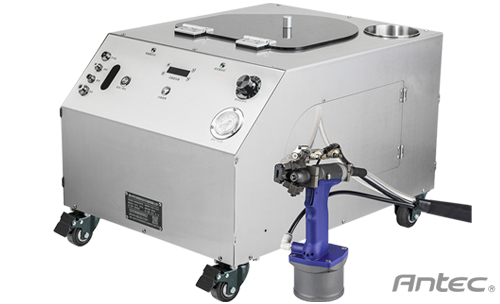
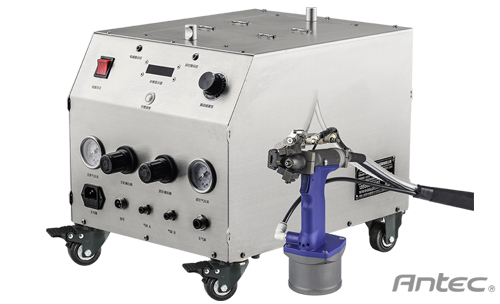
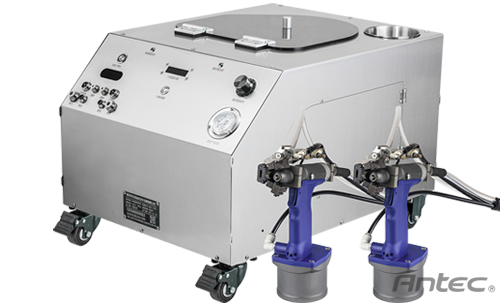
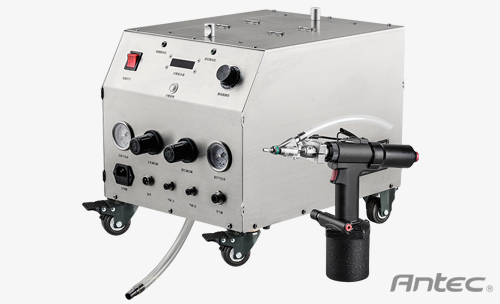
A handheld setup depends on the operator to locate each point, which suits high-mix low-volume work. A fixed worktable removes that locating error with pins and templates and suits small and medium parts with fixed rivet points. A dual-gun machine keeps two rivet points at a consistent relative position and a consistent cycle. A robotic riveting cell follows a program and has the best repeat positioning, which is why high-volume lines for automotive parts and EV battery trays run on it. The higher your output and the tighter the tolerance, the further up that ladder you should go; the four types are compared in auto-feed riveting gun types.
Riveting Accuracy FAQ
Supply Q&A
Most of the difference comes from the fixture, the hole tolerance on the part and the work standard, not from the machine itself. Align hole diameter, fixture datum and gun seating first; only then does comparing machines tell you anything.
Usually stack thickness variation, a rivet length outside the grip range for that stack, or unstable air pressure. Measure the actual stack and line pressure first, then check the rivet grip range and nosepiece spec.
Pick length by stack thickness, body material by workpiece material and head style by hole type. The full comparison is in our blind rivet selection guide.
Yes, but only against measured trial data. The roughly 70 cycles/min figure is a steady-state number; the capacity math is in riveting cycle time and capacity planning. Speeding up must never come at the cost of skipping first-article inspection.
Yes. We bring a matching machine to your plant, run your parts continuously and record position deviation, pull force and yield.
Auto-Feed Riveting Gun at a glance: 20,000 N pull force, 70 rivets per minute, bulk orders shipped worldwide, one-stop supply of machines, rivets and parts.
Bulk orders are packed and shipped together, with technical support included.
One supplier for the whole riveting process
Tell us what you buy today and in what volume. We will consolidate the machines, the consumables and the parts into one offer.
Further reading: Auto-Feed Riveting Gun buying guide (full series) · Custom project information checklist · Auto-Feed Riveting Gun selection help
 Previous