 You are here:
Automatic Riveting Equipment for Energy Storage PACK Lines - Procurement
Capacity expansion in the energy storage industry has driven strong demand for structural fabrication. From cell grouping and module PACK assembly to battery trays and storage cabinet frames, large volumes of aluminum extrusion and thin-gauge steel and aluminum parts all need reliable connections. Because these parts sit right next to the cells and are highly sensitive to heat and distortion, riveting, a cold joining process, is being adopted on storage lines faster than almost any other method. Automatic riveting equipment is now a standard part of that build-out.
Bulk buyers usually compare total cost per rivet rather than the machine price alone, because consumables and wear parts dominate that number. The notes below cover auto-feed riveting gun supply and procurement.
In short, for buyers who source machines, rivets and spare parts in one order: what makes energy storage structures different; where riveting is used; process and quality control points; configuring automatic riveting equipment.
1. What Makes Energy Storage Structures Different
Three characteristics stand out. Heat is a problem. Battery trays and PACK structures sit close to the cells, so welding heat input and spatter create both safety and quality risk, while cold riveting introduces no thermal distortion. There is a lot of aluminum. Trays are typically built from aluminum extrusion plus aluminum sheet, welded or riveted, and welding aluminum demands high operator skill and time-consuming straightening afterward. The cabinets are large and the rivet count is high. Storage cabinet frames and doors carry dense rivet patterns, where manual work is slow and missed rivets are common.
2. Where Riveting Is Used
| Location | What Is Joined | Recommended Process |
|---|---|---|
| Battery tray | Aluminum extrusion frame, base plate, reinforcement beams, lifting brackets | Structural rivets with automatic blind riveting or a robotic cell |
| PACK module structure | End plates, side plates, pressure plates, sensing harness brackets | Auto-feed blind rivets and rivet nuts |
| Electrical mounting plate | Busbar brackets, threaded mounting for electrical components | Hexagonal or knurled rivet nuts |
| Storage cabinet | Frame, doors, shelves, lifting hardware | Handheld auto-feed riveting or a fixed dedicated machine |
| Outdoor protective parts | Covers and watertight areas that must seal | Blind rivet nuts plus a sealing design |
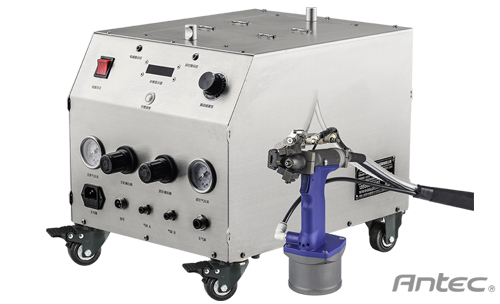
Specification customization is quoted with the machine, not as a separate negotiation.
3. Process and Quality Control Points
First, select fasteners by load path: structural rivets for the main frame connections, and rivet nuts wherever screws will be installed later. For the comparison, see the main types of rivet nuts. Second, follow the specification table for hole size and material thickness, and on hollow aluminum extrusion sections confirm there is support behind the joint so the wall does not bulge. Third, pull-out and shear test the critical joints, and keep first-article and audit records. Fourth, turn on the machine's rivet counter and miss-rivet function so the rivet count on every tray or cabinet matches the program, with an alarm if a rivet is skipped. Fifth, for large parts such as trays, a robotic or gantry-style automatic cell is the better fit, while a handheld high-force automatic rivet gun is more flexible on cabinets and doors.
4. Configuring Automatic Riveting Equipment
Storage products come in relatively few models with large batch sizes, so a dedicated-line approach pays off. Tray lines run mainly on fixed or robotic cells with fixtures that hold every rivet point in the same place. PACK and cabinet lines run mainly on handheld auto-feed tools, with operators moving along the station; one machine replaces roughly three people doing repetitive riveting by hand. Keep pneumatic tools for after-sales, rework and prototype areas. For background on the application, see riveting solutions for new energy and lithium battery storage. For rivet nut process details, see high-force rivet nut gun: uses, working principle and common questions.
Consumables ordered with the equipment avoid a second shipment later.
Energy Storage Riveting FAQ
Supply Q&A
Choose structural rivets to specification, control hole size and material thickness, and verify with pull-out testing. Riveted joints have a long track record on vibration resistance and anti-loosening in automotive and energy storage service.
In outdoor and humid environments, galvanic compatibility has to be considered. Aluminum or stainless steel rivets with a matching surface treatment are the usual options, and the supplier should recommend based on the service environment.
Cabinet lines use handheld auto-feed guns. Rivets travel to the nosepiece through a feed tube, so the operator simply works around the cabinet and the workpiece never moves.
Models with counting and error proofing track the rivet total and flag missed rivets. If you need point-by-point traceability, request it when specifying a fixed or robotic solution.
Yes. A Antec technician can bring the machine to your plant, run your tray or cabinet samples on site, and measure cycle time and first-pass yield.
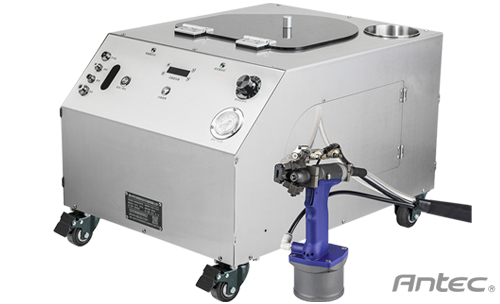
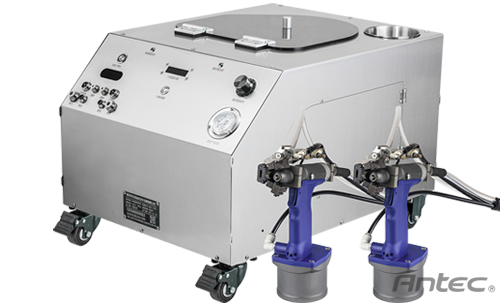
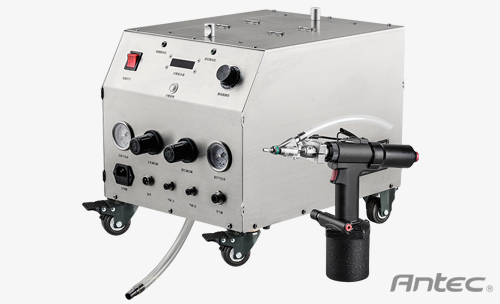
Auto-Feed Riveting Gun at a glance: 20,000 N pull force, 70 rivets per minute, bulk orders shipped worldwide, one-stop supply of machines, rivets and parts.
Send the annual rivet consumption and the equipment list - the team will quote the whole package in one offer.
One supplier for the whole riveting process
Tell us what you buy today and in what volume. We will consolidate the machines, the consumables and the parts into one offer.
5. Keeping Capacity Flexible During Expansion
Order flow in energy storage swings widely, and winning projects often demand concentrated delivery inside a short window. Plan the line as a fixed plus flexible combination: core large parts such as trays run on dedicated machines or robotic cells for cycle time and consistency, while PACK, cabinets and accessories run on handheld auto-feed equipment. Those handheld tools are not tied to a single product, so they can be redeployed to different stations as the order mix changes, and they do not sit idle in slow months. When a new project comes in, have the equipment supplier validate the process and measure cycle time on sample parts before deciding how many dedicated machines to buy, so the capital spend stays proportionate. On staffing, automated equipment reduces the job to loading, unloading and pulling the trigger, so new hires are productive after a short training session, which takes real pressure off hiring during expansion. For training and ramp-up timelines, see is the auto-feed riveting gun hard to operate.
Further reading: riveting process upgrades for new energy vehicle parts · high-force rivet nut guns in sheet metal fabrication · auto-feed riveting gun selection advice
 Previous